

When it comes to Islamic banking in Pakistan, one name consistently stands out: Meezan Bank. As the country’s largest and most trusted Shariah-compliant financial institution, Meezan has shown remarkable consistency in growth, profitability, and governance. But what does that mean for someone looking to invest with a long-term perspective? In this deep dive, we break down the bank’s financials, dividend history, and market position to help you understand whether Meezan still offers strong value in a changing economic climate and why it might deserve a place in your long-term investment portfolio.
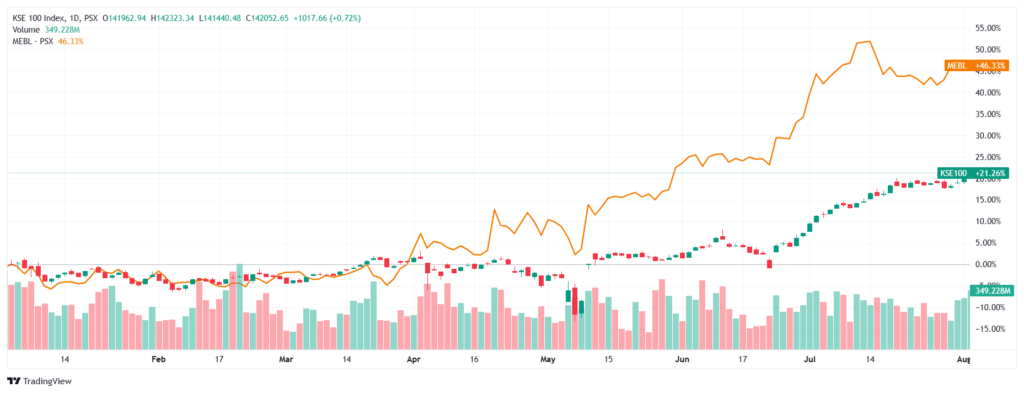
Company Overview & Business Model
Meezan Bank Limited, incorporated on January 27, 1997, began operations as Pakistan’s first full-fledged Scheduled Islamic Commercial Bank on March 20, 2002. As the country’s largest Islamic bank, it offers a wide range of Shariah-compliant services across corporate, retail, and investment banking.
Its revenue is driven by asset-backed financing, trade-based products, and sukuk investments. With a network of over 1,000 branches, it leads the Islamic banking sector in Pakistan.
Major shareholders include Noor Financial (~35%), Pak Kuwait Investment (~30%), and the Islamic Development Bank (~9%)
Recent Financial Performance
Income statement Five-year performance:
| Meezan Bank Limited | |||||
| INCOME STATEMENT | |||||
| Year | 2020 | 2021 | 2022 | 2023 | 2024 |
| Net Interest Income | 64.85 | 68.92 | 121.7 | 226.43 | 287.04 |
| Profit Before Tax | 36.94 | 47.5 | 88.38 | 169.41 | 222.09 |
| Taxation | 14.77 | 19.14 | 43.38 | 84.93 | 120.58 |
| Profit After Tax | 22.17 | 28.36 | 45.01 | 84.48 | 101.51 |
| EPS | 13.62 | 15.84 | 25.15 | 47.16 | 56.56 |
• Revenue Growth
Meezan Bank’s Net Interest Income rose from PKR 64.85B in 2020 to PKR 287.04B in 2024, reflecting a CAGR of over 40%. This growth is driven by expanding assets and rising Islamic financing activity.
• Gross and Net Profit Margins
Though gross margins aren’t directly reported in Islamic banking, net profit margins improved: ~34.2% in 2020 and ~35.4% in 2024. The consistent margin strength highlights cost efficiency and stable spreads despite higher taxes.
• Operating and Non-Operating Income
While exact figures aren’t available, the sharp increase in pre-tax profit (PKR 36.94B to PKR 222.09B) indicates that core operations are the primary profit drivers, supported by gains from sukuk and other non-core income.

Balance sheet Five-year performance:
| Meezan Bank Limited | |||||
| BALANCE SHEET | |||||
| Year | 2020 | 2021 | 2022 | 2023 | 2024 |
| Cash & Equivalents | 136.24 | 170.5 | 117.74 | 242.61 | 260.73 |
| Advances | 512.53 | 758.09 | 995.51 | 961.67 | 1,514.76 |
| Investments | 434.21 | 620.13 | 1,283.21 | 1,572.39 | 1,870.54 |
| Total Assets | 1,521.56 | 1,902.97 | 2,577.40 | 3,012.11 | 3,900.41 |
| Deposits | 1,254.43 | 1,455.89 | 1,658.49 | 2,217.47 | 2,584.87 |
Asset Growth & Composition
Total assets grew from PKR 1,521.56B in 2020 to PKR 3,900.41B in 2024 (~27% CAGR). Investments rose 4.3× to PKR 1,870.54B, while advances tripled to PKR 1,514.76B, reflecting strong growth in sukuk and Islamic financing.
Asset Quality
Current assets remain a small portion (PKR 309.12B in 2024), indicating long-term capital focus. While this signals confidence, it also requires careful liquidity oversight.
Liquidity Position
Cash & equivalents nearly doubled to PKR 260.73B, improving short-term flexibility and resilience against external shocks.
Deposit Base
Deposits increased from PKR 1,254.43B to PKR 2,584.87B—up ~106%—supporting robust lending and signaling strong depositor confidence in Meezan.
Capital Structure
Equity rose to PKR 246.98B, while liabilities hit PKR 3,653.43B, giving a typical bank-style debt-to-equity ratio of ~14.8×, reliant mainly on deposits and borrowings.

Cash flow statement Five-year performance:
| Meezan Bank Limited | ||||
| CASH FLOWS STATEMENT | ||||
| Year | Operating Cash Flow | Investing Cash Flow | Financing Cash Flow | Net Change in Cash |
| 2020 | –48,101.34 | –218,334.97 | 314,549.91 | 48,113.60 |
| 2021 | 33,802.02 | –193,805.39 | 191,247.54 | 31,244.20 |
| 2022 | 436,269.36 | –682,498.71 | 190,717.30 | –55,512.1 |
| 2023 | –123,680.88 | –281,001.80 | 525,116.32 | 120,433.60 |
| 2024 | –4,451.61 | –284,310.75 | 309,476.00 | 20,725.97 |
Operating Cash Flow
Meezan Bank’s operating cash flow was volatile, peaking at PKR 436B in 2022, turning negative in 2023 (–PKR 124B), and stabilizing near zero in 2024 (–PKR 4.5B)—reflecting fluctuating working capital and earnings quality.
Free Cash Flow (FCF)
FCF was strong in 2022 (+PKR 425B) but turned negative in 2023 and 2024, due to weaker operational inflows and high reinvestment, highlighting a growth-focused strategy.
CapEx Trends
Heavy and consistent capital expenditure across all five years, especially 2022–2024 (~PKR 280B+ annually), signals Meezan’s continued expansion in branches, infrastructure, and sukuk portfolios.

Valuation Metrics & Ratios
1. Profitability Ratios
- Return on Equity (ROE):
Shows how effectively the bank uses shareholders’ equity to generate net profits. ➤ MEBL (2025): 44.55% - Return on Assets (ROA):
Indicates how efficiently the bank utilizes its assets to produce net earnings. ➤ MEBL (2024): 2.85% - Net Profit Margin:
Indicates how much of the bank’s revenue is converted into net profit.
➤ MEBL (TTM): 32.80%
2. Valuation Ratios
- Price-to-Earnings (P/E):
Indicates how much investors are willing to pay for each rupee of earnings.
➤ MEBL (TTM): 6.62× - Price-to-Book (P/B):
Compares market value with book value per share.
➤ MEBL: 2.55×
3. Leverage Ratios
- Debt-to-Equity Ratio:
Reflects the proportion of funding from debt relative to equity.
➤ MEBL (July 2025): 2.59× — moderate leverage typical of banks. - Interest Coverage Ratio:
Measures the ability to pay interest from operating income.
➤ MEBL (2024): 1.57×
4. Liquidity Ratios
- Current Ratio:
Measures short-term financial health (current assets ÷ current liabilities).
➤ MEBL (2025): 1.13× — within industry norms. - Quick Ratio:
A stricter test of liquidity (excluding inventories).
➤ MEBL (2025): 0.96×
Dividend & Payout History
Dividend Yield and Payout Ratio:
| Year | Annual Dividend (PKR/share) | Dividend Yield | Payout Ratio |
| 2021 | ~5.50 | ~5.2% | ~39% |
| 2022 | 6.00 (approx.) | ~8.4% | ~24%† |
| 2023 | 15 | ~9.9% | ~52% |
| 2024 | 28 | ~10.9% | ~49% |
| 2025 (TTM) | ~28.00 | ~7.77% | ~52.9% |
• Dividend/share surged from PKR 6 in 2022 to PKR 28 by 2024, a substantial rise.
• Dividend yield peaked in 2023–24, then eased to 7.77% in mid-2025 as the share price increased.
• Payout ratio has remained consistently around 50–53% in recent years.

Consistency & Dividend Policy of Meezan Bank
Reliable Quarterly Payouts
Meezan Bank has consistently paid quarterly dividends from 2021 to Q1 2025, with a total of PKR 28/share in 2024 (PKR 7 per quarter) and PKR 7/share in Q1 2025, reflecting strong payout consistency.
Stable Payout Ratio
The dividend payout ratio has stabilized around 50–57%, reflecting a balanced approach between shareholder returns and capital retention.
Dividend Policy Framework
Though no formal policy is published, analysts suggest a target payout ratio of 50–55%, possibly increasing to 60% in 2025, indicating strong confidence in future earnings. The approach remains aligned with Shariah guidelines and regulatory expectations.
Industry & Market Position
Market Share & Competition:
Meezan Bank remains the largest Islamic bank in Pakistan, commanding ~33% of Islamic banking deposits as of Q1 2025. The Islamic banking sector overall now holds ~25% of total industry deposits, rising from 17–19% in 2020, signaling growing adoption.
Sector Growth Outlook:
Islamic banking assets are projected to grow ~12% annually in 2025, targeting 30% market share by 2026–27. Despite SBP’s push for 50% Islamic deposits by Jan 2025, actual penetration stood at 24.9% by Dec 2024, indicating lag behind targets.
Regulatory Environment:
Following the FSC’s 2022 directive to eliminate interest-based banking by 2027, SBP issued Circular IFPD-3 in 2024, requiring Islamic transition plans from all conventional banks. SBP’s 2025 Standard-47 mandates a 75% minimum return on Islamic savings—boosting customer protection and sector transparency.
Macroeconomic Drivers:
In 2025, with inflation at 3.2% and policy rate at 11%, economic conditions are stabilizing. Meezan Bank holds a strong deposit base (PKR 2.8 trn), NPLs under 2%, and a Capital Adequacy Ratio >27%, positioning it as a stable player amidst macro recovery.
Management & Governance of MEBL
Promoter Holding & Insider Trades:
Over 74% of Meezan Bank’s equity is held by top promoters—Noor Financial (35.2%), Pak Kuwait Investment (29.9%), and IDB (9.3%)—ensuring strong sponsor control with minimal public float. Insider holdings remain minimal at 0.36%, signaling stability and low internal trading risk.
Management Track Record:
Under the leadership of founding CEO Irfan Siddiqui since 1997, Meezan’s management has driven sustained growth. The experienced leadership team is highly credentialed in Islamic finance and risk management.
Transparency & Audit Reports:
Rated AAA (VIS) , the bank maintains strong compliance, with transparent SBP/SECP-aligned reporting, Shariah audits, and oversight from a well-structured audit committee.
Board Independence:
Meezan’s board includes independent directors and Shariah scholars, ensuring robust governance. Committees like Audit, Risk, and HR are well-structured and independently led.
Recent News, Events & Announcements
PSX Disclosures:
Meezan Bank regularly updates the PSX and its Investor Relations portal with timely disclosures, including financials, dividend notices, and board meeting alerts. A board meeting notice in August 2025 hinted at a major upcoming announcement.
Strategic Deals & Expansion:
In April 2025, Meezan joined a $52M fintech deal led by Haball, expanding Islamic supply chain finance in the Middle East. In June 2025, it co-financed a PKR 1.275T facility to help restructure Pakistan’s power sector debt—highlighting its leadership in national Islamic financing.
SECP / Regulatory Fines:
Meezan was fined PKR 106.2M in Q1 FY2024 by SBP for forex regulatory breaches, with recommendations to enhance compliance frameworks.
Political Risk:
No direct political interference has been reported. Meezan maintains close alignment with public policy but remains free from SECP investigations related to political influence.
External Economic Factors – Impact on Meezan Bank
Inflation rose to 4.1% in July 2025, prompting the SBP to maintain its policy rate at 11%, though a rate cut to 10.5% is expected. For Meezan Bank, this may narrow margins but boost loan demand. The PKR appreciated slightly after action against black-market forex, aiding official FX operations. However, informal trading poses ongoing compliance risks.
The Uraan Pakistan 2024–29 initiative backs key macroeconomic reforms, strengthening Meezan’s long-term growth prospects. Yet, tight fiscal policies may limit credit growth and pressure earnings. Rising energy tariffs have raised costs for borrowers, especially SMEs, increasing default risks and potential provisioning needs for Meezan.
Conclusion
Meezan Bank stands out as Pakistan’s leading Islamic financial institution, combining strong fundamentals with consistent profitability and disciplined growth. Its robust performance across income, asset expansion, and capital adequacy reflects a well-managed strategy rooted in Shariah-compliant finance. With a steadily growing dividend, low non-performing loans, and a capital adequacy ratio above 27%, the bank remains financially sound and investor-friendly.
Despite macroeconomic challenges such as inflation, energy cost pressures, and regulatory tightening, Meezan’s leadership, strong deposit base, and expanding role in national Islamic finance position it well for long-term stability. The planned shift to a fully Islamic banking system by 2027 further solidifies Meezan’s strategic edge.
Looking ahead, continued investment in digital infrastructure, a balanced dividend policy, and prudent risk management will be key to sustaining growth.
For investors and stakeholders, Meezan Bank offers a resilient, ethical, and forward-looking financial model well-aligned with both national policy and market trends.
Read More about about how the PSX performed in June 2025


No responses yet